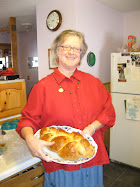
Beginning today, it is Great and Holy Lent in the Eastern Church, and the blog is about to undergo a refashioning and a remodelling as I pass through the 40 day spiritual cycle. Prayer, fasting and almsgiving are at the forefront and politics and the world must take a back seat and cool their heels while the Lenten Spring works its resurrection magic on us. So don't be surprised at a new look, and some late winter/early spring doings coming to The Rosemary Tree soon! A good Lent to you.
Showing posts with label Eastern Rite Catholic. Show all posts
Showing posts with label Eastern Rite Catholic. Show all posts
Monday, February 15, 2010


Wednesday, August 12, 2009
The Rosemary Tree Mission Statement
 Blog owner Deborah Yost
 One of the feedburners has asked for an author's description of the blog, so here it is. And please tell your friends about our little corner of the Web. Thank You!
The Rosemary Tree is a Melkite (Byzantine Rite Catholic) blog which examines eclectic subject matter including politics, finance, peak oil/climate change, film and music in the light of a Catholic worldview. Unlike some "religous blogs", however, we write for a broad audience, not only for those who think like us. Comment is invited and welcomed. Associate bloggers ExRanger and Stanford Espedal give different facets to this little gem.
At The Rosemary Tree we strive for a rest in the shade, some cool water and a little civility, if not chivalry. This blog is dedicated to Our Lord Jesus Christ, Mother Mary, Saint Joseph, Saint Patrick, Saint Deborah and the glorious St. Bridget of Kildare. People who visit should feel as though they've had a moment of respite from the chaos of modern life. I very much like the line in the poem on my right-hand sidebar about the ancient knight - "His helmet now shall make a hive for bees;" It's reminiscent of " beating swords into ploughshares" a sentiment I also heartily approve of.
Monday, June 1, 2009
Taste and See That The Lord, He is Good
The music of the ancient Christian Church, whose roots have budded in modern times.
Dear Friends of the Melkite Mission of Lincoln NE,
Our next Divine Liturgy will be the First Sunday of June (6/7) at St. George Ukrainian Catholic Church, 3330 North 13th Street, Lincoln.
As always, the Divine Liturgy will be preceded by Morning Prayer. So please remember to come early.
There is now a table at the coffee social where you can purchase Eastern Christian books, CDs, artwork, and jewelry (at the present time it is cash only).
Don't forget to visit our new site on the internet with a lot of new information intended to answer common questions about the Divine Liturgy (recently added Videos and Audio).
http://melkitenebraska.blogspot.com
The schedule for Sunday is as follows:
9:30 AM Morning Prayer
10:00AM Divine Liturgy followed by Potluck
For more information call: (402) 797-3703
Dear Friends of the Melkite Mission of Lincoln NE,
Our next Divine Liturgy will be the First Sunday of June (6/7) at St. George Ukrainian Catholic Church, 3330 North 13th Street, Lincoln.
As always, the Divine Liturgy will be preceded by Morning Prayer. So please remember to come early.
There is now a table at the coffee social where you can purchase Eastern Christian books, CDs, artwork, and jewelry (at the present time it is cash only).
Don't forget to visit our new site on the internet with a lot of new information intended to answer common questions about the Divine Liturgy (recently added Videos and Audio).
http://melkitenebraska.blogspot.com
The schedule for Sunday is as follows:
9:30 AM Morning Prayer
10:00AM Divine Liturgy followed by Potluck
For more information call: (402) 797-3703
Monday, March 30, 2009
Melkite Divine Liturgy This Weekend

Dear Friends of the Melkite Mission of Lincoln NE,
The next Divine Liturgy for our community will be Palm Sunday at St. George Ukrainian Catholic Church, 3330 North 13th Street, Lincoln. It is customary to wave palm branches in procession around the outside of the Church before the Divine Liturgy, so remember to come early. There will also be a small gift 'shop' at the coffee social where you can purchase Eastern Christian books, CDs, artwork, and religous jewelry (at the present time it is cash only). And don't forget to visit our new site on the internet with a lot of new information intended to answer common questions about the Divine Liturgy.
The schedule for Palm Sunday is as follows:
4/5 Sunday
9:30 AM Morning Prayer
9:50 AM Outdoor procession with Palm Branches
10:00 AM Divine Liturgy followed by a potluck meal: In accordance with the Great Fast, please avoid bringing foods with eggs, dairy, meat, and fish (shellfish is ok).
Fr. Daniel will be available for Holy Confession during Morning Prayer. Please pass this message on to whomever you think might be interested.For more information call: (402) 797-3703 or visit http://melkitenebraska.blogspot.com/
Blessed is he who comes in the Name of the Lord!
He is the King of Israel ~ He is the King of Kings!
~~~~
Saturday, February 7, 2009
Who Are the Eastern Catholics?
Catherine Alexander speaks with Father Maximos of Holy Resurrection Romanian Catholic Monastery in Newberry Springs, CA about Eastern Catholic identity.
Questions Asked:
1. Some people say Eastern Catholics are Roman Catholics of an Eastern rite, some say they are orthodox Christians who are currently in communion with Rome, and some say Eastern Catholics are primarily a bridge of unity between East and West. I'd like to discuss each of these three positions with you.
2. I'd like to discuss the title, "Roman Catholics of an Eastern rite." The emphasis is that they're Catholic first, and believe all things that the Roman Catholic Church believes, while living out that faith through a different liturgical and devotional framework. Will you discuss what it means to be an Eastern Catholic in light of this title?
3. Some people say that Eastern Catholics are Orthodox Christians in communion with Rome as a means of asserting the Eastern Catholic Churches' independence from Rome and their unity with Orthodoxy, especially in the areas of history, theology, and spirituality. What do you think the benefits and pitfalls are of using this title to describe the relationship Eastern Catholics have with Rome?
Part 1
Part 2
Questions Asked:
1. Some people say Eastern Catholics are Roman Catholics of an Eastern rite, some say they are orthodox Christians who are currently in communion with Rome, and some say Eastern Catholics are primarily a bridge of unity between East and West. I'd like to discuss each of these three positions with you.
2. I'd like to discuss the title, "Roman Catholics of an Eastern rite." The emphasis is that they're Catholic first, and believe all things that the Roman Catholic Church believes, while living out that faith through a different liturgical and devotional framework. Will you discuss what it means to be an Eastern Catholic in light of this title?
3. Some people say that Eastern Catholics are Orthodox Christians in communion with Rome as a means of asserting the Eastern Catholic Churches' independence from Rome and their unity with Orthodoxy, especially in the areas of history, theology, and spirituality. What do you think the benefits and pitfalls are of using this title to describe the relationship Eastern Catholics have with Rome?
Part 1
Part 2
Friday, February 6, 2009
Another Orthodox Rosary: The Jesus Prayer

An Eastern Orthodox rosary (the beads not the prayer) is known as a "Chotki". This Oriental form of rosary is known in the Hellenic Greek Church as Chaplet or String of Knots of Beads(komboskini) in the Russian Church as Vervitza (string), chotki (chaplet), or liestovka (ladder), and the the Rumanian Church as matanie (reverence). Our everyday name of "beads" for it is simply the Old Saxon word "bede" (a prayer) which has been transferred to the instrument used in reciting the prayer, while the word rosary is an equally modern term.
The "Jesus Prayer" Rosary prayed by the Eastern Orthodox is a string of 33, 100, or 300 beads on a string or knots made of wool; they are not divided into decades. (I have a 33 knot wool chotki bracelet which travels nicely on the wrist.)
On each bead or knot is prayed the following "glorious" mantra: "Lord Jesus Christ, Son of the Living God, have mercy on me, a sinner." The modern Chotki, as it is known, calls for a slightly different mantra: "Lord Jesus Christ, Son of God, have mercy on me, a sinner." Both this mantra and the Glorious mantra above are derived from the Gospel story of the Pharisee and the tax collector.
Two men went up to the temple to pray, one a Pharisee and the other a tax collector. The Pharisee stood and prayed thus with himself, 'God, I thank Thee that I am not like other men--extortionists, unjust, adulterers, or even as this tax collector. I fast twice a week; I give tithes of all that I possess'. But the tax collector, standing afar off, would not so much as raise his eyes to heaven, but beat his breast, saying, 'God, be merciful to me a sinner!' I tell you, this man went down to his house justified rather than the other; for everyone who exalts himself will be humbled, and he who humbles himself will be exalted. (Luke 18.10-14)
and listen to St. Andrew of Crete: 'Boastful am I, and hard of heart, all in vain and for nothing. Condemn me not with the Pharisee, but rather grant unto me the humility of the Publican, O only merciful and just Judge, and number me with him' (Great Canon, Ode 4).
(The Hail Mary, of course, comes from the Angelic Salutation coupled with a later additional prayer.)
From Bishop Kallistos Ware:
QUOTE There is one type of private prayer, widely used in the west since the time of the Counter-Reformation, which has never been a feature of Orthodox spirituality - the formal 'Meditation,' made according to a 'Method' - the Ignatian, the Sulpician, the Salesian, or some other. Orthodox are encouraged to read the Bible or the Fathers slowly and thoughtfully; but such an exercise, while regarded as altogether excellent, is not considered to constitute prayer, nor has it been systematized and reduced to a 'Method.' Each is urged to read in the way that he finds most helpful.
But while Orthodox do not practise discursive Meditation, there is another type of personal prayer which has for many centuries played an extraordinarily important part in the life of Orthodoxy - the Jesus Prayer:
"Lord Jesus Christ, Son of God, have mercy on me a sinner."
Since it is sometimes said that Orthodox do not pay sufficient attention to the person of the Incarnate Christ, it is worth pointing out that this - surely the most classic of all Orthodox prayers - is essentially a Christo-centric prayer, a prayer addressed to and concentrated upon the Lord Jesus. Those brought up in the tradition of the Jesus Prayer are never allowed for one moment to forget the Incarnate Christ.
As a help in reciting this prayer many Orthodox use a rosary, differing somewhat in structure from the western rosary; an Orthodox rosary is often made of wool, so that unlike a string of beads it makes no noise.
The Jesus Prayer is a prayer of marvelous versatility. It is a prayer for beginners, but equally a prayer that leads to the deepest mysteries of the contemplative life. It can be used by anyone, at any time, in any place: standing in queues, walking, traveling on buses or trains; when at work; when unable to sleep at night; at times of special anxiety when it is impossible to concentrate upon other kinds of prayer. But while of course every Christian can use the Prayer at odd moments in this way, it is a different matter to recite it more or less continually and to use the physical exercises which have become associated with it.
Orthodox spiritual writers insist that those who use the Jesus Prayer systematically should, if possible, place themselves under the guidance of an experienced director and do nothing on their own initiative.
For some there comes a time when the Jesus Prayer 'enters into the heart,' so that it is no longer recited by a deliberate effort, but recites itself spontaneously, continuing even when a man talks or writes, present in his dreams, waking him up in the morning.
In the words of Saint Isaac the Syrian: 'When the Spirit takes its dwelling-place in a man he does not cease to pray, because the Spirit will constantly pray in him. Then, neither when he sleeps, nor when he is awake, will prayer be cut off from his soul; but when he eats and when he drinks, when he lies down or when he does any work, even when he is immersed in sleep, the perfumes of prayer will breathe in his heart spontaneously' (Mystic Treatises, edited by Wensinck, p. 174).
Orthodox believe that the power of God is present in the Name of Jesus, so that the invocation of this Divine Name acts 'as an effective sign of God's action, as a sort of sacrament' (Un Moine de l’Église d’Orient, La Priére de Jésus, Chevetogne, 1952, p. 87). 'The Name of Jesus, present in the human heart, communicates to it the power of deification ... Shining through the heart, the light of the Name of Jesus illuminates all the universe' (S. Bulgakov, The Orthodox Church, pp. 170-171). UNQUOTE
~~~
Monday, December 1, 2008
Melkite MIssion of Lincoln

For those of you in the neighborhood ~ come taste the riches of the Christian East...
Dear Friends of the Melkite Mission of Lincoln NE,
We are pleased to announce that Fr. Daniel Lenz will be offering the Divine Liturgy for the continuation of our services this Sunday. Services will be held at St. George Ukrainian Catholic Church, 3330 North 13th Street, Lincoln. The schedule is as follows:
12/7/08 Sunday
9:30 AM Morning Prayer
10:00 AM Divine Liturgy followed by a potluck meal
(Remember that we are in the midst of the Nativity Fast so no dishes with meat, fish, dairy, or eggs, Thank you).
Fr. Daniel will be available for Holy Confession before the Divine Liturgy. Please pass this message on to whomever you think might be interested.
For more information call: (402) 797-3703.
In Christ,
Sebastian Carnazzo
~~~~~~~
Monday, August 4, 2008
Head Coverings Redux

Having received some attention to the recent post on Veiling the Sacred, I have been doing some more reading on the subject and found a personal account of Christian head covering over at the Orthodox Christian Information Center which rings very true to me. I mean, if covering one's head in church allows us to participate more fully in the life of The Theotokos and makes us more harmonious with our Guardian Angel, what's not to like? The author's experience rings true and resonates with my personal experience. Amen, Elisabet! Now, if wearing a beret could only make me look like the model above ~ wait; it does? At least a little bit? Ah ha! When women realize head coverings are gorgeous, the churches wil be full of them, say what? If purity doesn't do it perhaps vanity will...
Here is an exerpt, but please click on over and read the whole thing.
QUOTE In 1995 I was chrismated Orthodox and was surprised to find myself again the only woman wearing a head-covering in my parish. An Orthodox sister told me, with a nod to my scarf, "We don't have to wear that anymore." I smiled and said, "I know, but I want to." St. Paul had said "ought," not "must." It was my voluntary obedience, even if I didn't understand the "why's." By now I had no intention of giving up the benefits. I felt blessed and protected, feminine, and, paradoxically, confident and free—in the presence of guardian and ministering angels.
In Orthodox worship the angels were even more in evidence. The Divine Liturgy is full of references to the various ranks of angels, emphasizing our participation with them in the joyous worship of the Holy Trinity. St. John Chrysostom (d. A.D. 407), in a sermon at the Feast of the Ascension, spoke both of angels and the veiling of women: "The angels are present hereOpen the eyes of faith and look upon this sight. For if the very air is filled with angels, how much more so the Church! ...Hear the Apostle teaching this, when he bids the women to cover their heads with a veil because of the presence of the angels." UNQUOTE
In Orthodox worship the angels were even more in evidence. The Divine Liturgy is full of references to the various ranks of angels, emphasizing our participation with them in the joyous worship of the Holy Trinity. St. John Chrysostom (d. A.D. 407), in a sermon at the Feast of the Ascension, spoke both of angels and the veiling of women: "The angels are present hereOpen the eyes of faith and look upon this sight. For if the very air is filled with angels, how much more so the Church! ...Hear the Apostle teaching this, when he bids the women to cover their heads with a veil because of the presence of the angels." UNQUOTE
Subscribe to:
Posts (Atom)