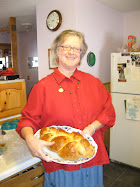
One hears frequently that one is a reprobate female for wearing a veil in Church. Some veiled ladies visiting modernist churches have overheard a whisper that a "Muslim" was visiting (this when covered Melkite-style - I've been Christian all my life); others question the veiled woman's self-esteem, feminist credentials or orientation to the men in her life. I have, as recently as today, been refused, in a Novus Ordo Mass, the Sign of Peace, refused eye contact and refused conversation, I guess because the head covering makes people uncomortable.
For myself, I was told by Traditionalist friends that it was a good Catholic sacred tradition which had been tossed out, like baby with the bathwater, after Vatican II. I have gradually tried it out of respect for the Melkite and Latin parishes where I frequently visit, and now maintain the custom even when I visit modern (Novus Ordo) churches.
Here is a fantastic explanation of the veiling custom by Lincoln' s own Father Robert Fromageot, FSSP. I heard him give this homily at Saint Francis last autumn, and it is nice to find this except online at
Stony Creek Digest.
Veiling the Sacred
QUOTE Among the many different ways in which the sense of the sacred is brought out during the liturgy, the use of veils is perhaps the most obvious one. Whatever contains or is meant to contain the Blessed Sacrament is usually veiled: the tabernacle, the chalice, the ciborium, the monstrance. And even when the veil is removed from the chalice, the liturgy provides other ways to veil it.
At each moment of the double consecration, when the celebrant pronounces the words that brings forth Our Lord upon the altar in the species of bread and wine, he bends over the bread and wine, and places his arms upon the altar, the symbol of Christ. Such a gesture is meant to show the priest’s union with Christ at that moment, while also helping the priest to focus his entire attention on the consecration. Physically speaking, however, the priest is literally covering the species, veiling them, as it were, and thus producing the same effect as any other veil: namely, he manifests the sacredness of the moment of Consecration. In this way, the ancient rite gently inculcates in the faithful a proper disposition towards Our Lord contained in the Blessed Sacrament.
Consider also, the function of those things which are ordinarily veiled: the tabernacle, the chalice, etc. All of these are vessels of the very Source of life, Our Lord and Savior Jesus Christ, the Light and Life and of the World. It is because these vessels are designated to contain Christ Himself that they are sacred vessels; hence, they are used for no other purpose than to receive and contain the Blessed Sacrament. At one time, only bishops, priests, and deacons were permitted to open the tabernacle, handle the sacred vessels, and touch the Sacred Host with their hands. All of these vessels, moreover, but especially the chalice, are usually made with great care out of gold and silver, jewels and precious stones.
Finally, the chalice is the only vessel that is consecrated by a bishop and anointed with oil. Little wonder, then, that the chalice veil is invariably the most beautiful of all the veils found in the sanctuary.
Taking our cue from the use of veils in the sanctuary, we can say that every woman who embraces the ancient tradition of wearing a veil creates a wonderful harmony between herself as a vessel of life and the vessels that hold Life itself. Like Our Lord contained in the Blessed Sacrament, a woman shares with Him a certain vulnerability. For just as a person who does not respect the Body and Blood of Christ can have his way with the Lord by receiving Him unworthily, so too can a man who has no respect for the opposite sex easily overpower her and have his way with her. Moreover, just as Our Lord makes Himself vulnerable by being born anew upon our altars under the perishable species of bread and wine, so too a woman shares in the vulnerability of her newborn infant in the very act of giving birth to him, to say nothing of the extra help many women need when they are pregnant.
Women are also sacred, inasmuch as the rise or fall of civilizations depends largely on how men regard and treat them, and how women understand and treat themselves. Just as only those who have committed themselves to the Lord through a life of celibacy may justly touch the Holy Eucharist with their hands, so too only those men who have committed themselves to their wives through the bonds of holy matrimony may justly “touch” a woman in a way that may bring new life into the world. For women are vessels of new life, life made according to the image and likeness of God Himself, just as the tabernacle, chalice, and ciborium contain the Image of God, Our Lord Jesus Christ.
Of all the sacred vessels, however, women are best likened to the chalice of the Precious Blood. For when a woman conceives and bears a child, it is through her blood that the life of the child is sustained and nourished. Similarly, the Bride of Christ, the Church, is said to sustain her members through the Blood of Christ. For just as Eve was taken from the side of Adam, the fathers of the Church see in the blood and water flowing from the side of Our Lord the birth of His Church: the New Eve, the Bride of Christ, which sustains and nourishes her members through the grace of the sacraments.
The leading lights of our age often claim to champion the rights of women, and in certain respects the claim is legitimate. At the same time, however, our age has clearly not sought to protect and foster the sacred dignity of women. On the contrary, society would have us remove our wedding garment, divest ourselves of Christ, and put on the “old man” and make ample provision for the flesh.
Men are practically encouraged to treat women as mere objects of pleasure, and women are encouraged to seek this degrading form of attention and accept it as normal and compatible with their dignity. Men and women, but especially women, have become desensitized to using contraceptives, choosing abortion, and embracing sterilization. In short, our society no longer respects or values the gift of fertility; society no longer honors the unique privilege of being a woman. Consequently, it no longer cultivates the responsibility that necessarily accompanies this gift, this privilege. This collective failure on the part of society has wreaked havoc, and it is far from certain that we shall recover and escape dissolution and destruction.
Sadly, some forty years ago millions of Catholics decided to put on the old man when they rejected the teaching of the Church concerning contraception. Around the same time, the ancient tradition of wearing veils or head coverings of any sort was likewise abandoned. Knowing what the veil stands for, it is difficult to not to regard that these two events — the rejection of the Church’s teaching on contraception on the one hand and the liturgical practice of wearing veils and head coverings on the other — as wholly unrelated. Indeed, many took both events as a step forward in the emancipation of women from so-called male dominance.
But as members of the Mystical Body of Christ, we should know better. We have all been called to the wedding banquet of the Lamb; we have received our wedding garment. Knowing, therefore, that many are called but few are chosen, let us cherish that garment and pray never to be without it. On the contrary, let us ever implore the divine assistance always to “put off the old man” with all of its deceitful lusts, and ever strive to be renewed in the spirit of our minds. Let us “put on the Lord Jesus Christ and make no provision for the flesh.” UNQUOTE

 The Legion of Mary was established in Ireland in 1921 and took root in the Lincoln Diocese in 1957, officially beginning in 1959. This lay apostolic group assists pastors in performing spiritual works in their parishes. Last night at St. Mary's Catholic Church in downtown Lincoln, Nebraska we celebrated the Extraordinary Form of Mass (Latin Rite) with the assistance of the priests and seminarians of the FSSP and laity from St. Francis Catholic Church (a FSSP Oratory) and took vows of total consecration to Our Lord Jesus Christ, through consecration to the Most Holy Mother of God. Bishop Fabian Bruskewitz presided and a reception followed. I believe I was the only Melkite member of the LOM present, and for my dear husband, who is Greek Orthodox, it was his first Latin Mass. A memorable evening!